Six rounds to light the tunnel walls: Fable 5.1 + Claude Code on a fractal sponge
The same fractal tunnel prompt: Fable 5.1 inside Claude Code, 69 turns, $4.80, six render rounds. Five of them oscillated between overexposure and invisible dust; the sixth swapped in a point light ahead of the camera plus half-Lambert shading, which is what finally fixed walls that went dark at grazing angles.
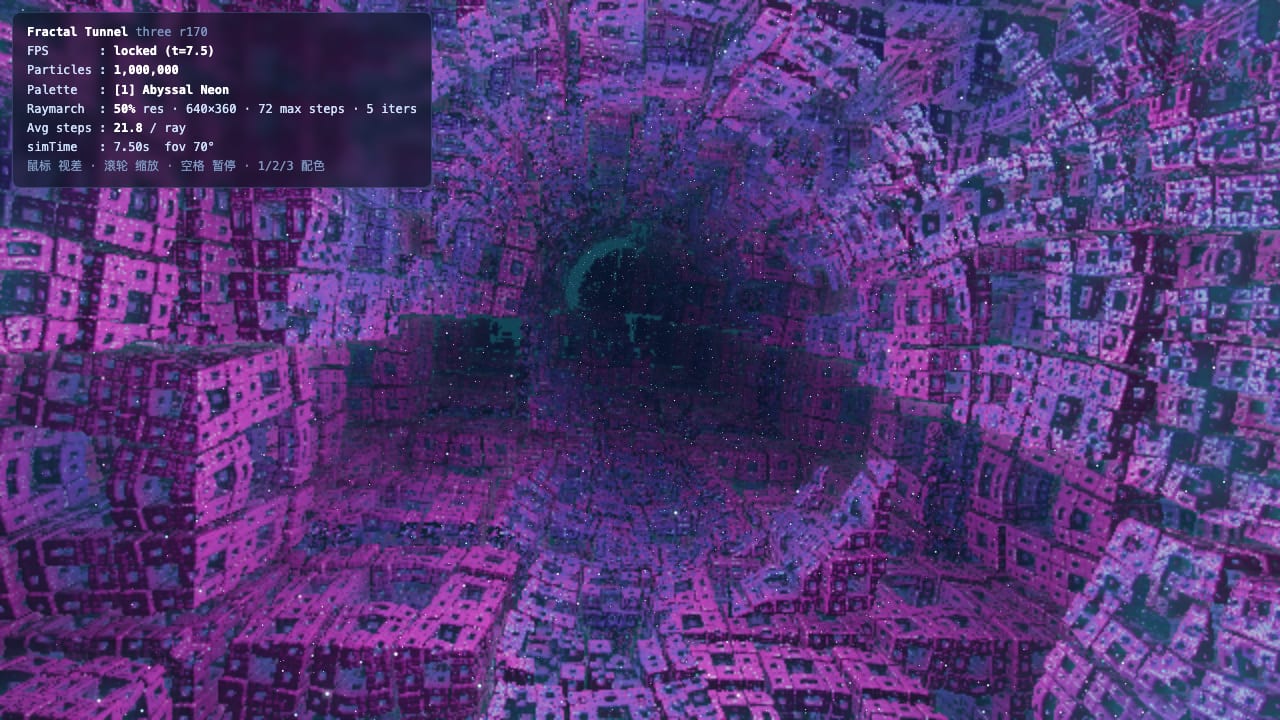
The on-screen labels are in Chinese: this is the model's verbatim output from an experiment run in Chinese, and editing it would make the artifact something other than what was measured.
How it was made
- Model
- Claude Fable 5.1 + Claude Code
- us.anthropic.claude-fable-5-1
- How
- agent loop
- Claude Code 2.1.266
- Reasoning effort
- high
- Turns
- 69
- Tool calls
- 68
- Output tokens
- 59.7k
- Wall time
- 18m 11s
- Cost
- $4.80
- Artifact
- 664 lines, one file
- Error feedback
- none
Six render rounds, and the first five trace one curve:
- Badly overexposed — the dust haze and the glow term were both too strong.
- – 3. Exposure corrected, but now the dust was invisible and the lighting flat.
- – 5. Depth and fog strengthened so the dust became “a few bright, most dim”.
- Final: switched to a point light ahead of the camera plus half-Lambert shading, which fixed tunnel walls going dark at grazing angles.
Round 6 is worth calling out on its own: “the walls are too dark at grazing angles” is a problem with the lighting model, not with a badly tuned parameter. Five rounds went into adjusting exposure and fog values; only the sixth changed the algorithm. That kind of judgement — this cannot be tuned, it has to be replaced — comes only from looking at the rendered frame repeatedly.
Final numbers: __DEMO_READY=true, __DEMO_ERROR=null, no page, console or request
errors; two matching hashes at ?t=7.5&det=1; first frame in 1.8–3.1 seconds and about
1.1 FPS under SwiftShader; the raymarch runs at 50% resolution by default (640×360) at
roughly 21 steps per ray; and at t=7.5, t=30 and in live mode mean luminance sits at
0.27–0.35 — neither black nor blown out, with the far end of the tunnel darkening
correctly and the dust sparks visible and properly occluded by the fractal.
Implementation: the fractal is a KIFS variant of the Menger sponge (rotate, fold, sort,
scale) tiled on a 4-unit period, with a tunnel carved along a curved path driven by
simTime; scale, fold offset and rotation all “breathe” slowly over time. The raymarch
renders into a HalfFloat target (rgb for colour, a for hit distance); a composite pass
upscales it and converts the distance into gl_FragDepthEXT, which is what the million
dust points depth-test against — the same approach as
the Astra run, at a different density and palette.
A few URL parameters are left exposed for tinkering: rm (raymarch resolution ratio),
steps, iter and dust.
Controls: mouse for parallax, scroll to zoom, space to pause, 1/2/3 for palettes
(Abyssal Neon, Ember Core, Verdant Circuit), ?t= to freeze the clock.
Same prompt, other runs
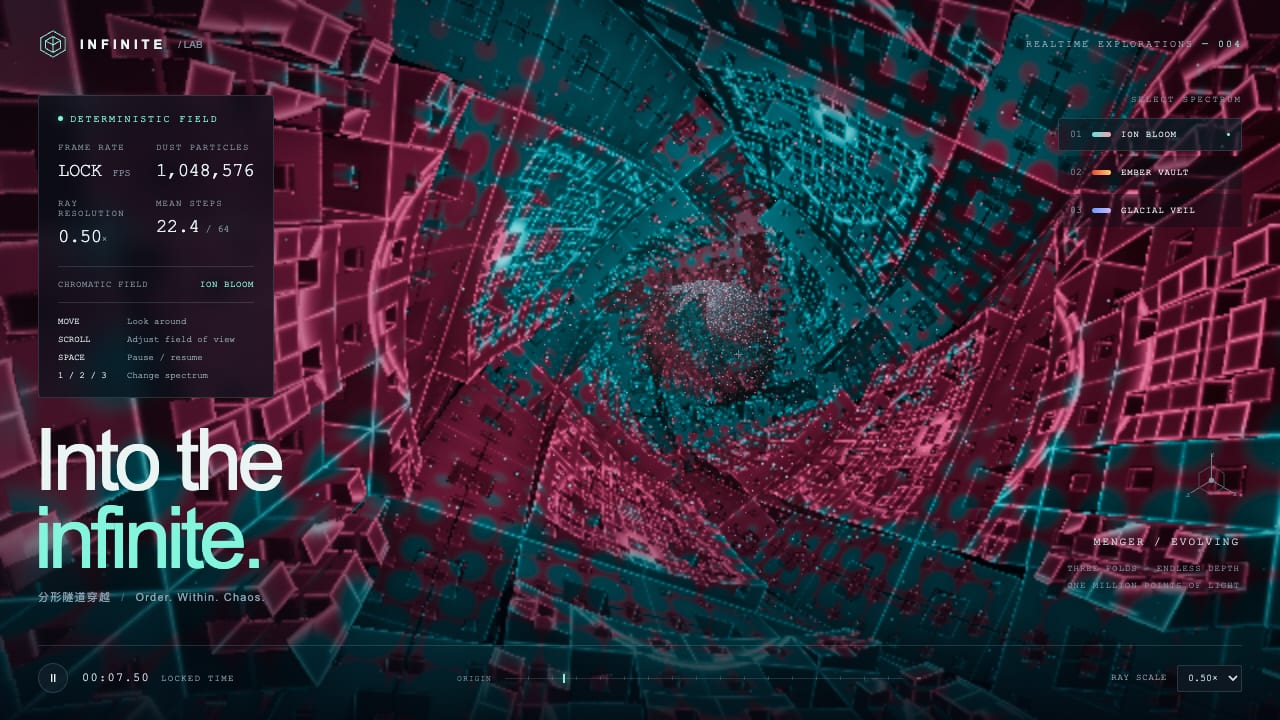
three.js r170 is served from this site, so running a demo makes no third-party request. Published by the author as an individual; testing was self-funded and nothing here represents an employer's position.