Hands-on · Reality checks · Postmortems
AI tools I paid for and ran,
numbers I checked, failures I debugged.
No launch-post summaries. Every hands-on piece states what it cost, where it broke, and who it is actually for — including the parts that did not work.
Start here
First time here? These three say what this site is for.
- 01 Seedance 2.5 Hands-On: 725 Credits Buy 27 Seconds, and the CLI Costs Extra A ¥69/month membership buys 725 credits — enough for 27 seconds of finished video, about ¥2.5 per second. The Dreamina CLI needs the ¥998/month premium tier, which is where my agent-driven pipeline stopped. Three blockers, one cost calculation done on what I actually paid, and four things wrong with the subtitles. → Why it is here: I paid for it, ran it, and wrote down the limits the vendor does not mention
- 02 DeepSeek V4 Pro Goes GA: Third-Party Benchmarks Don't Match the Leaked Scorecard DeepSeek V4 Pro 0813 launches as a GA release. Artificial Analysis gives it 53 points, ranking 23rd. The leaked agent benchmark table claims 87.9 on Terminal Bench — beating Opus 4.8 — but independent testing shows 79%, a 9-point gap that flips the result. Here's the full cross-check. → Why it is here: I cross-check published numbers instead of repeating them
- 03 The Mysterious 400 in Claude Multi-Turn Chats: Debugging a Thinking Signature Corruption A customer's Claude extended-thinking conversations kept failing with 400 Invalid signature — but only on some gateway channels. A full postmortem: what the signature mechanism is, how a proxy's JSON re-serialization silently corrupts base64, five controlled experiments that pinned it down, and a fix checklist for every LLM gateway developer. → Why it is here: I debug the problems nobody else has written up
Columns
All columns →Each column is a promise: a hands-on states what it cost, a postmortem names a root cause and a fix.
Hands-on Labs
5Products I paid for and actually ran, with the price, the limits and the failures
Reality Check
5Official numbers cross-checked against independent measurements
Postmortems
3A real failure, the experiments that isolated it, the root cause and the fix
Building
12Things I actually built with agents, including the steps that did not work
Explainers
29How a system works, explained from zero with diagrams
Commentary
6Where I stand on something, argued from public information rather than measured
Tools
All tools →Run the numbers from the articles yourself.
Experiments you can run
All demos →The same prompt handed to different models, with the output running in your browser. Each one records which model made it, in how many turns, how long and what it cost.

Event horizon in one shot: a million-particle black hole

Night city: 3,707 buildings and 1.04 million raindrops on one InstancedMesh
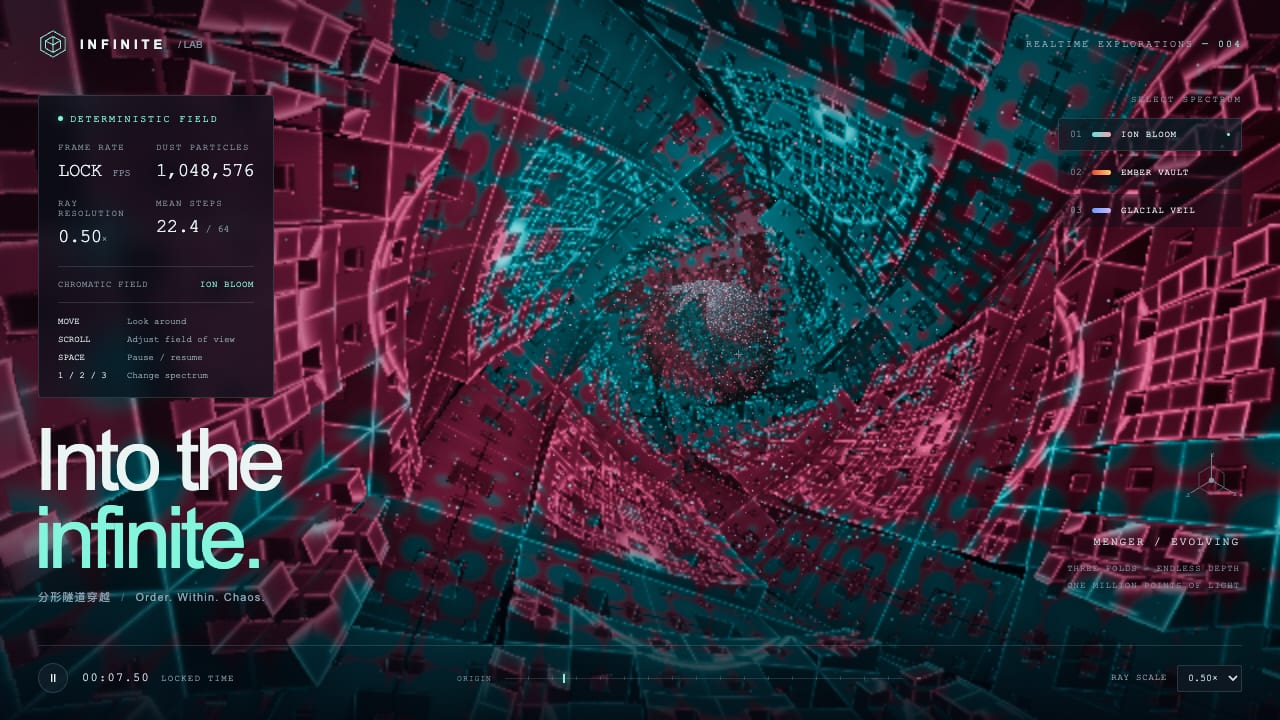
Fractal tunnel: writing raymarch depth so a million points are occluded properly
Latest articles
60 total · view all →
I Self-Hosted MiniMax H3 on an L40S: What Is Actually Open
MiniMax H3 runs on a 48 GB L40S with INT8 weights, but H3-Base is only the middle stage. Here is what worked, what failed, what it cost, and when self-hosting wins.

I Stopped Chasing New Model Releases. The Hallucinations Didn't Stop.
In half a year the flagship Opus shipped four generations at a flat price, and I used the newest daily — yet my hallucinations never dropped. Six things I couldn't explain, one by one.
Prompt Caching (Part 4): AWS Documents 4,096 — I Measured 1,024
AWS gives Claude Sonnet 4.5 a 4,096-token minimum cacheable prefix. Bisecting on Bedrock put the real threshold at 1,024. Three control models matched their docs; only this row was off.
Prompt Caching (Part 1): What Is Actually Cached
Prompt caching saves the server's prefill compute, not the cost of re-sending tokens. Where the KV cache comes from, why a prefix must match token for token, and why caching can cost more.
Prompt Caching (Part 2): Five Vendors, Three Clouds, One Bill
AWS documents a 4,096-token minimum for Sonnet 4.5 on Bedrock; I measured 1,024. Multipliers, TTL tiers and cross-region behaviour for five vendors — measured kept apart from documented.
Prompt Caching (Part 3): It Is On and Not Hitting — Now What
Cache invalidation almost never errors: inference succeeds, the logs are clean, only the bill grows. Four culprits by frequency, plus a cross-vendor hit-rate self-check you can run today.
Browse by topic
Get new posts by email
One email when a new article goes up. No ads, unsubscribe in one click.
Your address is used for post notifications only.
About this site
- Written by zhuermu, a cloud and AI engineer. Everything here is a personal opinion.
- Public sources and my own test environment only — never an employer's internal information.
- Every hands-on says who paid: self-funded, vendor-provided, or sponsored.
- Prices and versions move, so articles carry an update log rather than being replaced.